Blog · 24 October 2026 · Shane O’Connor
Citeplane vs Profound for winning AI answers at dev-tool companies
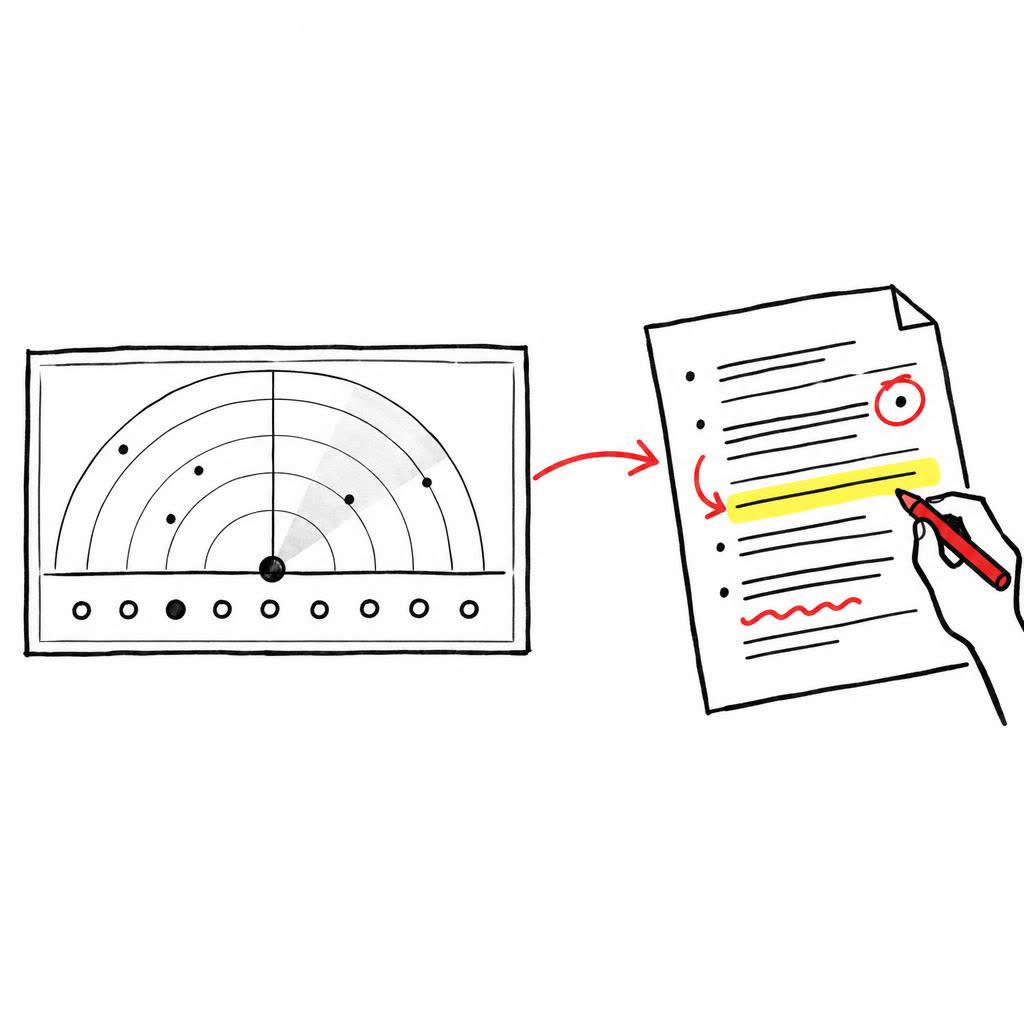
Profound’s Enterprise plan tracks up to 9 answer engines daily and runs credit-based marketing agents (Profound pricing). Citeplane finds the buyer questions a dev-tool or AI company loses and writes the page that should win: Growth is $999 a month for 100 buyer questions re-asked weekly plus 8 finished pages. Citeplane tracks Claude today, so pick Profound if you need ChatGPT, Perplexity or Gemini data now.
Citeplane publishes this page, so this is a vendor’s comparison. Profound’s plans, engine lists and prices come from Profound’s own pages, including its Profound vs Rankability article, checked October 2026. Scalenut’s review is quoted by name.
Profound is the stronger product when your gap is measurement: Enterprise tracks up to 9 answer engines daily, and Citeplane tracks one, Claude, weekly. Citeplane is built for the dev-tool or AI company whose gap is the page itself: a comparison, migration or architecture page with numbers an engineer will check. Citeplane ends each lost question in a fact-checked page that a person on your team approves, shipped as a pull request to your docs repo or to your CMS.
Citeplane vs Profound at a glance
A cell that says a feature “is not described” or “is not mentioned” on the pages checked means Profound’s pricing page, docs and blog posts linked here did not mention it in October 2026. The feature may still exist, so ask Profound.
| Attribute | Citeplane | Profound (checked October 2026) |
|---|---|---|
| Primary job and buyer | Finds the buyer questions a dev-tool, data or AI company loses in AI answers and writes the page that should win, from the company’s own evidence | “An agentic marketing platform purpose-built for Answer Engine Optimization (AEO)” for “enterprise brands and agencies running dedicated AEO programs” (Profound vs Rankability, June 2026) |
| AI engines tracked today | Claude with live web search; ChatGPT built, not switched on; Perplexity and Gemini planned | Trial: ChatGPT, Gemini, Google AI Overviews. Enterprise: up to 9 from ChatGPT, Perplexity, Google AI Mode, Gemini, Microsoft Copilot, DeepSeek, Anthropic Claude, Google AI Overviews, Exa Search (pricing) |
| How answers are collected and re-checked | Asks each buyer question to Claude with live web search and records the sources the answer cites; re-asked every week on Growth | “Runs structured prompts across AI platforms”, tracking citations, sentiment, ranking and competitive presence; daily on Enterprise, daily for 7 days on Trial (pricing) |
| Site audit | Up to 500 pages from the sitemap, scored for crawl and AI access, structured data, metadata, answer extractability and AI-readable files such as llms.txt, judged by page type; re-audited monthly on Growth | Agent Analytics: server-side tracking of AI crawler behavior and referrals from host and CDN logs (integrations post); a page-scoring audit is not described on the pages checked |
| Free starting point | Free instant AEO audit: up to 40 pages, about a minute, no email or card | Trial: 50 prompts run daily for 7 days, limited AI Marketer credits, a recommended prompt set you cannot customize (pricing) |
| Content production | 8 finished pages a month on Growth, drafted from engineers’ answers, internal docs and call transcripts | AI Marketer (Aim) and Agents, run on credits; Agents built by Aim, by your team, or from “several dozen templates” (Profound vs Rankability) |
| Accuracy controls | Each number must appear in the client’s facts or a cited source; each link must point at a real source or a real page on the client’s site; a separate pass checks every claim against its source | FactCheck flags inaccurate claims AI models make about your brand; Context Manager holds brand knowledge (Profound vs Rankability); a source-tracing step for numbers in generated drafts is not described on the pages checked |
| Human approval | A person on the client’s team approves every page; Citeplane never publishes on its own | “Your team approves before publication” for Aim projects; Contentful drafts can queue for editorial review (Contentful post) |
| Publishing targets | Framer, Webflow, GitHub pull request with Mintlify, Docusaurus, Starlight and Nextra presets, or any CMS by webhook, with structured data | Workflow nodes for Basehub, Contentful, Framer, Notion, Payload, Sanity, Webflow, WordPress; Vercel page deploys; Call API node for REST or GraphQL (docs) |
| Developer tooling | MCP server for Claude Code and Cursor | API and CSV or JSON exports on Enterprise; a next-aeo package for Next.js sites; an MCP server is not mentioned on the pages checked |
| Pricing | Growth $999 a month, cancel any time, 100 buyer questions tracked weekly and 8 finished pages a month; Enterprise priced to the plan (pricing) | Brands: Trial free, Enterprise custom via demo; agencies: self-serve Agency Growth plan with 400 credits per month per client workspace (pricing) |
| Availability and maturity | Early access with a small group of design partners (early access) | Free trial with self-serve “Get Started” and setup listed as “Instant”; Enterprise adds SSO/SAML, SOC 2 and a support option of a dedicated specialist with a 24 hour SLA (pricing) |
Which AI engines does each tool track today?
Citeplane currently asks a company’s buyer questions to Claude with live web search and records the sources each answer cites. ChatGPT tracking is built but not yet switched on, and Perplexity and Gemini are planned, with no dates given (how it works). On the Growth plan, each tracked question is asked again every week (pricing).
Profound’s pricing page lists Enterprise as “Up to 9 Answer Engines tracked,” with capability for ChatGPT, Perplexity, Google AI Mode, Gemini, Microsoft Copilot, DeepSeek, Anthropic Claude, Google AI Overviews and Exa Search. Enterprise prompts run daily, and ChatGPT Shopping is an Enterprise feature (Profound pricing, checked October 2026). The free Trial covers ChatGPT, Gemini and Google AI Overviews. A team evaluating Profound on the Trial will not see Claude data until it moves to Enterprise.
For each lost question, Citeplane records the pages Claude cited instead of yours. Claude reads the web through its own search crawler, Claude-SearchBot, which obeys its own robots.txt rule (more on that in what AEO changes compared with SEO). Those cited pages are the brief for the page Citeplane writes next.
What does each tool do after it finds a question you are losing?
Citeplane writes the page that should win the lost question, drawing on the company’s own evidence, and the Growth plan includes 8 finished pages a month (pricing). Before drafting, Citeplane asks the client’s engineers questions only they can answer. It can draft those answers from internal docs and call transcripts, which stay private (how it works), so engineers review drafted answers instead of starting from a blank page.
Profound’s answer is an agentic layer your team runs. According to Profound, its AI Marketer (Aim) “ranks projects against 2B+ real user prompts, with evidence attached.” The projects span content, accuracy corrections, sentiment, earned media and customer questions, and Aim “builds the Agents to carry out each project.” A Context Manager keeps positioning, products, audience and strategy in six Brand Records that shape proposals and output (Profound vs Rankability, June 2026). Agents run on credits, and each run consumes credits “relative to its complexity” (Profound pricing). Profound Sheets runs Agents at scale.
With Profound you operate the system: choose or build Agents, budget credits, wire Workflows to a CMS and decide where review happens. With Citeplane on Growth, the month ends with 8 pages waiting for one person on your team to approve.
For a dev-tool company, the scarce input for a comparison or migration page is what engineers know: the conditions behind a benchmark, the failure mode in a migration, the reason for an architecture decision. Profound’s Context Manager stores positioning, products, audience and strategy in six Brand Records. Citeplane’s intake is built around engineer questions about what the pages AI cites today do not know.
How does each tool keep generated content accurate?
In every Citeplane draft, each number must appear in the client’s facts or a cited source, and each link must point at a real source or a real page on the client’s site. A separate fact-check pass then checks every claim in the draft against its source. A person on the client’s team approves every page, and Citeplane never publishes on its own (how it works).
Profound’s FactCheck watches the other direction: it “flags inaccurate claims AI models make about your brand and the sources repeating them,” and Aim turns each one into a correction project (Profound vs Rankability). On the output side, Profound says “your team approves before publication” for Aim projects, its Contentful node can “queue drafts for editorial review rather than auto-publishing” (Contentful post), and a Slack node can route drafts to reviewers (Slack post). Profound’s pages checked for this comparison do not describe a step that traces each number in a generated draft back to a source (October 2026).
Profound’s FactCheck catches what AI models get wrong about your brand. Citeplane’s source tracing catches a number in your own draft that has no source. They answer different risks, so ask each vendor to show you the check that matches yours.
How does each tool audit your site for AI readability?
The full Citeplane audit scores up to 500 pages from a site’s sitemap for crawl and AI access, structured data, metadata, answer extractability and AI-readable files such as llms.txt. It judges each page by its type: core pages, guides and comparisons, docs and blog. On Growth, the site is re-audited every month (pricing). The free instant AEO audit reads up to 40 pages, takes about a minute and needs no email or card.
Profound’s Agent Analytics works from your host and CDN logs. It provides “server-side tracking of AI crawler behavior and referrals” through native integrations with Vercel, AWS CloudFront (via Amazon Data Firehose), Cloudflare Workers or Logpush, Fastly and Netlify. It needs no JavaScript and checks crawler identity by cross-checking IP addresses against the published ranges of OpenAI, Anthropic and Google (Profound integrations post, July 2025). The October 2026 pricing page lists Akamai, Google Analytics, Google Cloud Platform and WordPress as well (pricing).
Citeplane’s audit flags a docs page with no JSON-LD before any crawler arrives. Agent Analytics tells you, from your CloudFront or Cloudflare logs, whether Claude-SearchBot ever requested it.
Two commands check the basics before you buy either tool. The first fetches only the headers for llms.txt; the second prints robots.txt:
curl -sIL https://<your-domain>/llms.txt
curl -s https://<your-domain>/robots.txt
With -L, curl follows redirects and prints a status line for each hop; the last one is the final status. A not-found status, or a redirect that lands on your homepage instead of the file, means AI tools asking for llms.txt get nothing. In robots.txt, look for explicit rules for Claude-SearchBot and OAI-SearchBot, because each obeys its own rule, separate from the training crawlers:
User-agent: Claude-SearchBot
Allow: /

User-agent: OAI-SearchBot
Allow: /
A blanket Disallow: / under User-agent: * with no exceptions keeps these crawlers out too.
Where do finished pages end up?
Approved Citeplane pages publish, with their structured data, to Framer or Webflow, as a GitHub pull request, or to any CMS through a webhook. The GitHub option has presets for Mintlify, Docusaurus, Starlight and Nextra (how it works). Citeplane also runs an MCP server, so Claude Code and Cursor can work with a Citeplane workspace.
On a Mintlify, Docusaurus, Starlight or Nextra site, the pull request lands in the repository your docs already build from. The engineer who owns a benchmark comments on the exact line, any CI you already run on docs PRs runs against it, and merging is the publish step. Ask the Citeplane team for the PR file layout and webhook payload during onboarding.
Profound’s Workflows connect to Basehub, Contentful, Framer, Notion, Payload, Sanity, Webflow and WordPress. A Vercel node can “generate and deploy new web pages directly from within a workflow,” and a Call API node reaches any REST or GraphQL API. Profound also lists outputs to Slack, Gamma and Google Drive (Profound docs, checked October 2026). The Contentful and Slack posts say those Agent integrations are available to Enterprise customers (Contentful post). The workflow docs list no GitHub or docs-framework integration. If your marketing site runs on Contentful, Sanity or WordPress, Profound covers it directly.
What do Citeplane and Profound cost?
Citeplane Growth is $999 a month, cancel any time, for 100 buyer questions tracked weekly and 8 finished pages a month. Enterprise is priced to the plan (pricing). Citeplane is in early access with a small group of design partners (early access), so this describes the plan, not open self-serve signup.
Profound’s pricing page, checked in October 2026, lists two plans for brands: Trial at “Free” and Enterprise at “Custom” with “Get a Demo.” Agents are priced on credits, and “the self-serve Agency Growth plan comes with 400 credits per month per client workspace” (Profound pricing). The page text checked does not show a dollar price for the Agency Growth plan. A February 2026 post on Profound’s blog lists Profound as “Starts at $99/month” (Profound blog). That figure does not appear among the brand plans on the October 2026 pricing page, so confirm with Profound’s sales team.
Scalenut’s review reads Profound’s pricing the same way: “ongoing paid brand pricing is custom,” and pricing and complexity are “the main trade-offs” (Scalenut).
For the content side of the budget, specialist technical content agencies cost $5,000 to $15,000 a month (Hackmamba pricing). That is a reference point for what written technical pages cost today, not a savings calculation.
When should you choose Profound?
Profound is the better choice when you need daily data from more engines than Claude: Enterprise tracks up to 9, and even the free Trial covers ChatGPT, Gemini and Google AI Overviews (Profound pricing). If leadership wants ChatGPT numbers this quarter, Profound provides them today and Citeplane does not: its ChatGPT tracking is built but not switched on.
Profound also fits a team that has to buy this week and pass a security review. The Trial has a self-serve “Get Started” button, and Enterprise lists SSO/SAML, SOC 2 compliance and support options up to a dedicated specialist with a 24 hour SLA (pricing). Citeplane is in early access with design partners.
If you already have writers and the missing piece is measurement, Agent Analytics tracks AI crawler visits and AI-sourced traffic from your host or CDN logs, Prompt Volumes shows what users ask AI engines, and Enterprise adds all-time data history, CSV and JSON exports and an API (pricing).
For agencies, Profound has a self-serve Agency Growth plan that includes 400 Agent credits per month per client workspace, and both brand plans list unlimited seats (pricing). Workflows accept multiple CMS accounts in one organization (docs). Profound’s FAQ says its Agents cover researching a market, shaping a campaign and writing content, with workflows for recurring tasks (pricing).
Skye Scofield, Marketing Lead at Statsig, is quoted on Profound’s pricing page: “We chose Profound because it seemed like the deepest and most complete tool in the market.” Scalenut’s review leads with the same point: “Profound Goes Deep On AI Search Intelligence” (Scalenut).
When does Citeplane fit better?
Citeplane fits a dev-tool or AI company that already knows roughly which buyer questions it loses and lacks the technical pages engineers trust enough to win them.
Run this test on your lost questions. If they read like “X vs Y for <job>” or “how do I migrate from Y”, and the answer depends on a benchmark or migration path that your engineers can describe and the cited pages cannot, Citeplane’s intake starts from those engineers. If they are brand-sentiment or category-awareness prompts, Profound’s Aim projects cover more of that work.
If your docs run on Mintlify, Docusaurus, Starlight or Nextra, pages arrive as GitHub pull requests through a preset, with structured data. If your engineers work in Claude Code or Cursor, the Citeplane MCP server gives those tools access to the workspace (how it works).
The tradeoff: tracking runs on Claude today, and you join as a design partner during early access.
How do you move from Profound to Citeplane, or run both?
Keep Profound for multi-engine tracking and run Citeplane on the questions where you need pages. Profound Enterprise lists CSV and JSON exports (pricing); ask whether they include your tracked prompts, or copy the prompts by hand.
- Run the free instant AEO audit, then apply at early access.
- Pick up to 100 buyer questions where a page would change the answer.
- Answer the engineer questions, choose where pages publish, and review the first ones like any pull request. Check a live page carries structured data:
curl -s https://<your-domain>/<new-page> | grep -c 'application/ld+json'- Compare the sources Claude cites in Citeplane with Profound’s data each week, then decide whether to keep both.
Frequently asked questions
Does Citeplane track ChatGPT, Perplexity or Gemini yet?
No. Citeplane asks buyer questions to Claude with live web search today. ChatGPT tracking is built but not yet switched on, and Perplexity and Gemini are planned, with no dates given. If you need those engines now, Profound Enterprise tracks up to 9 answer engines daily (Profound pricing, checked October 2026).
Can I sign up for Citeplane today, or is it invite only?
Citeplane is in early access with a small group of design partners, so you apply at early access and cannot buy self-serve. The free instant AEO audit is open to anyone and needs no email or card.
Will Citeplane publish pages to my site without my approval?
No. A person on your team approves every page, and Citeplane never publishes on its own. With the GitHub option, the page arrives as a pull request, so merging it is your decision.
Does Citeplane work with Mintlify or Docusaurus docs?
Yes. Approved pages can publish as a GitHub pull request with presets for Mintlify, Docusaurus, Starlight and Nextra, carrying their structured data. Framer, Webflow and webhook publishing to any CMS are also supported.
Can I keep Profound for tracking and use Citeplane just for writing pages?
Yes, and that is the lowest-risk way to trial Citeplane. Growth bundles 100 weekly-tracked questions with 8 pages a month, so point those questions at the ones you want pages for. If you need a different mix, Enterprise is priced to the plan.
How much does Profound cost compared with Citeplane’s $999 Growth plan?
Profound’s pricing page (checked October 2026) lists a free Trial and custom Enterprise pricing for brands, plus a self-serve Agency Growth plan with 400 credits per month per client workspace. The page text checked shows no list price to compare directly. Citeplane Growth is $999 a month, cancel any time, for 100 buyer questions tracked weekly and 8 finished pages a month.
See where you stand first.
The free AEO audit scores how well AI engines can read and quote your pages, by part of your site, with the fixes in order. About a minute, no email.