How it works
Quoted by AI.
Trusted by
engineers.
AI decides whether your page gets quoted. The engineer who clicks through decides whether you get the deal. Citeplane writes pages for both: specific enough for ChatGPT and Claude to lift, and rigorous enough that a senior engineer finishes reading and thinks, these people know what they’re talking about. Every number traced to your docs, your benchmarks or your engineers. No marketing BS.
Run the free audit first → Apply for early access →
Built by the author of GTM Co-Founder, open-source go-to-market skills for dev-tool founders: MIT licensed, 321 stars on GitHub (21 October 2026).
“Blazing-fast sync for modern data teams.”
“3x faster on 10M-row Postgres replication, measured on this hardware.”[benchmark ↗]
An illustration from AI quotes specifics. Whether they’re true is on you.
Two readers
Most AEO writes for the model. The engineer reads it next.
- The model wants specifics.In the GEO study, adding statistics, quotations and citations to a page raised its visibility in AI answers by up to 40% on the benchmark, and up to 37% on Perplexity.[1] Vague copy rarely gets lifted.
- The engineer checks them.46% of developers say they distrust the accuracy of AI tools, and 75.3% would still ask a person when they don’t trust an answer.[2] When that person lands on your page, it has to answer like an expert.
- So write for both.Content written only to get picked up gets found out on the first click. Citeplane builds each page around your own evidence, cites competitors from their own pages, asks your engineers what the pages AI cites today don’t know, and blocks any number it can’t trace.
What it costs you
Miss either reader, and you lose the deal.
- AI can’t quote you, so you’re not on the shortlist.An AI answer names a handful of tools, built from pages it can quote. A benchmark in a slide deck or a config in a repo can’t be quoted, so it can’t be part of that answer.
- Someone else describes your product.When your own pages don’t answer the question, AI fills the gap from competitors’ comparison posts and roundups, in their words, not yours.
- The engineer doesn’t trust what they find.A citation sends a skeptical reader to your page. If it reads like marketing, or one number doesn’t hold up, the page that brought them in becomes the reason they leave.
The listicle problem
“The LLM will cite a source from a competitor.”
A commenter on Hacker News[3]
When a developer asks an AI which tool to use, it builds the answer from pages it can quote: comparison posts, “best tools for” lists, pricing breakdowns. Whoever wrote the most quotable page wins the answer, whether or not its claims hold up.
That cuts both ways. A vendor’s roundup can win the citation and still lose the reader, because the engineer who clicks through knows exactly what they’re reading. The page that wins both is specific, sourced, and written with the people who built the product.
Why now. Developers now ask ChatGPT, Claude and their coding agents which tool to use. A thread on which tools Claude Code picks drew 611 points on Hacker News.[4] If your evidence is not on a page the engine can quote, it cannot be part of that answer.
What you have tried
Why the usual fixes don’t fix it.
How it works
From the questions you lose to pages that hold up.
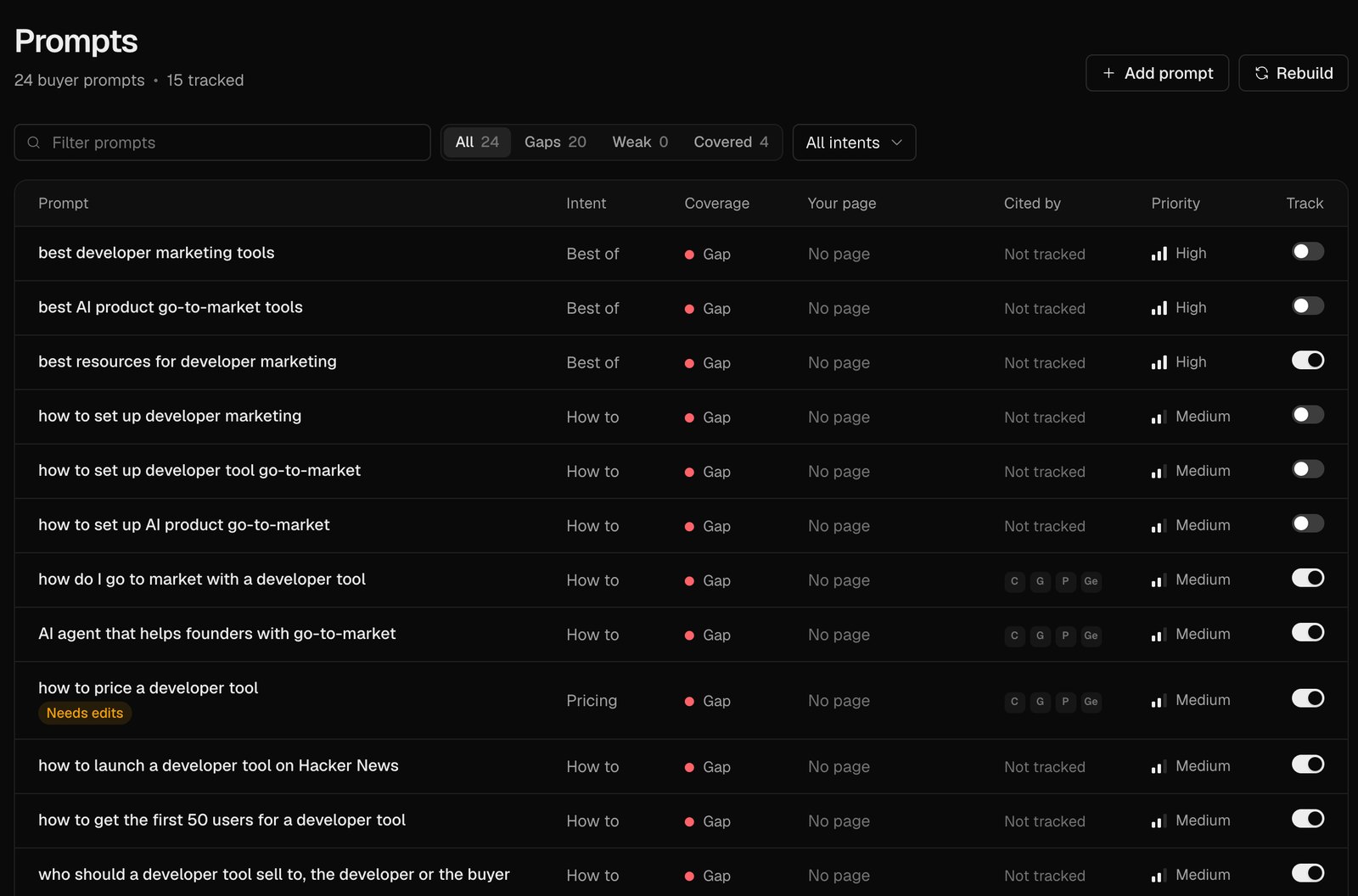
See the questions you are losing.
You get the questions your buyers ask, asked to Claude with live web search, with the sources each answer cites. ChatGPT support is built; Perplexity and Gemini are planned. You see which you win, which you lose, and the pages that win them instead.
Before: you guess which comparisons matter. After: your buyer questions, ranked, with who Claude cites for each.
Turn your evidence into pages.
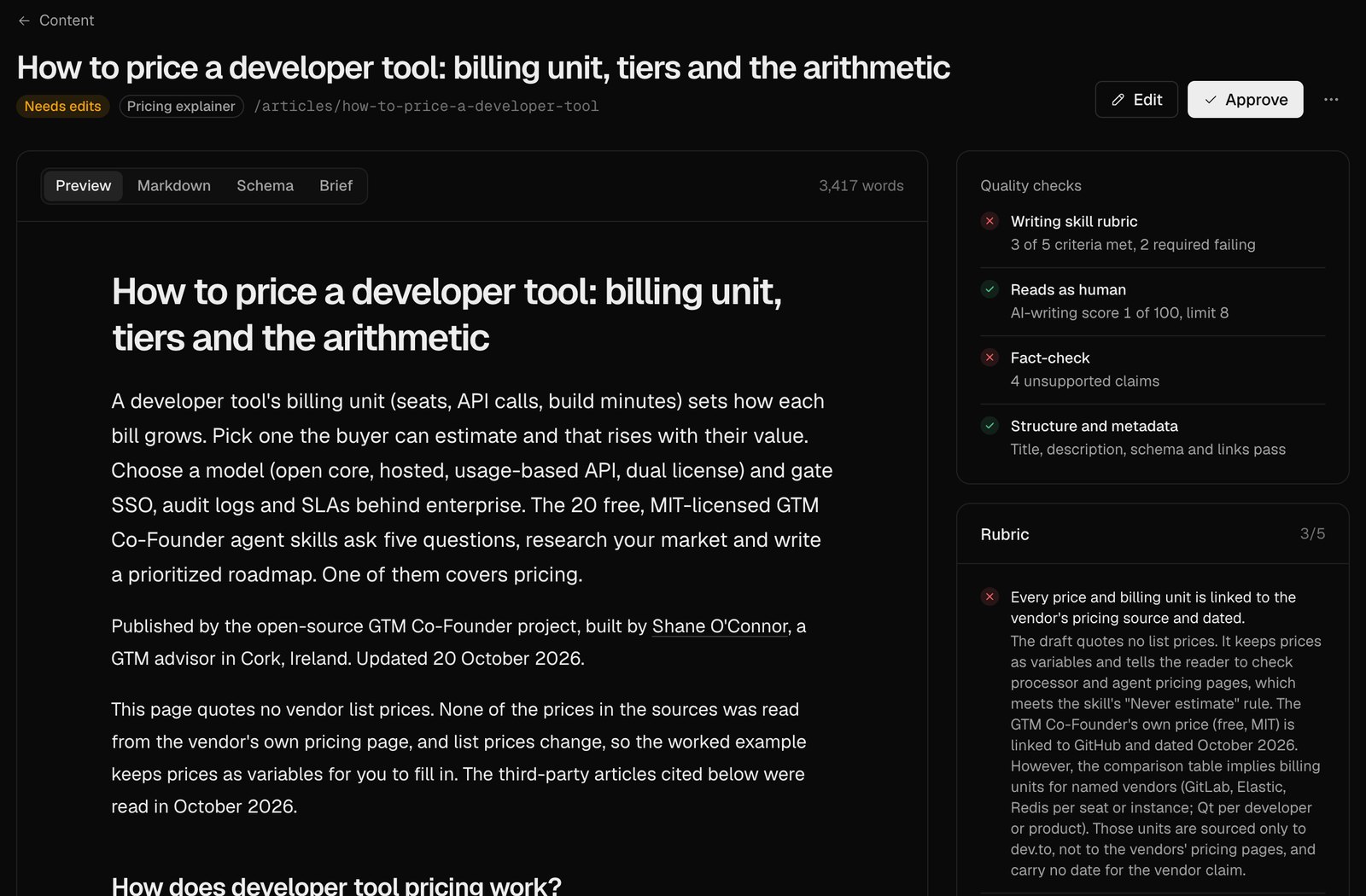
For each gap, Citeplane first asks your engineer a few questions only they can answer, and can draft those answers from your internal docs and call transcripts, which stay private. Then it writes the page that answers the question better, from your facts and those answers, after reading the pages that win today and, for comparison and pricing pages, the competitor’s own pages.
Before: a blank page, or a writer who doesn’t know your product. After: a draft built from your benchmarks and docs, with its sources.
Nothing ships unchecked.
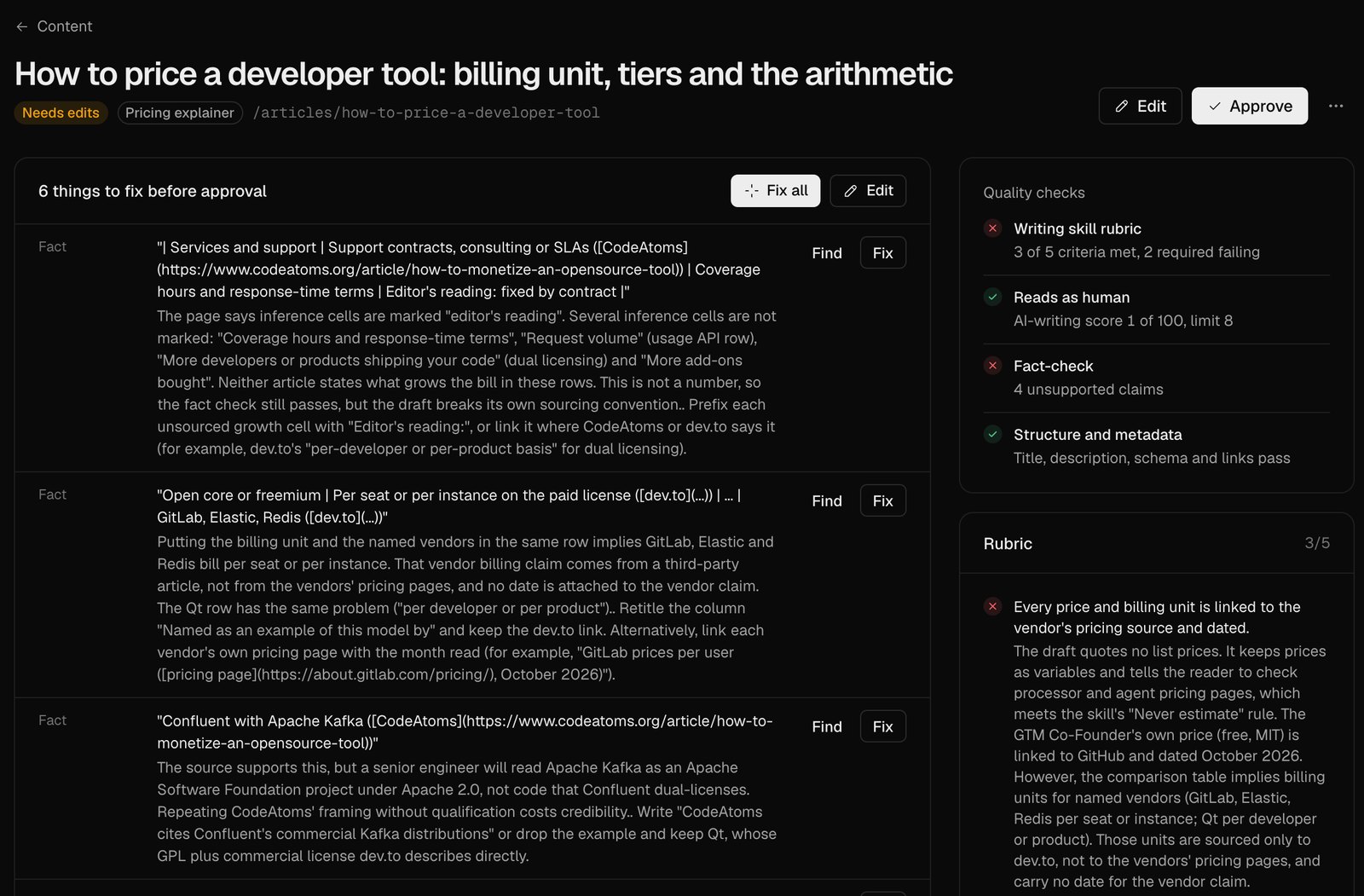
Every number must appear in your facts or a cited source. Every link must point at a real source or a real page on your site. A separate fact-check pass checks every claim against its source. Anything that echoes a private source is blocked. Want something changed? Say it in plain words and every check runs again. Citeplane never publishes on its own: a person on your team approves every page.
Before: one wrong number on a comparison page, found by a skeptical developer. After: every number traced, every problem flagged with a fix, and a person signs off.
Publish where your site lives.
Approve a page and send it straight into Framer or Webflow, open a pull request on GitHub (Mintlify, Docusaurus, Starlight and Nextra included), or post it to any CMS through a webhook. The structured data goes with it. Working in Claude Code or Cursor? Connect them to Citeplane through its MCP server.
Before: copy, paste, and the schema gets lost on the way. After: one click from approved to your CMS, then tracking checks whether AI cites it.
- FramerCMS collection, same slug updates
- WebflowStaged, or this page live
- GitHubPull request, docs presets
- WebhookZapier, Make, n8n, any CMS
- MCP serverClaude Code, Cursor
Proof
Anything it can’t trace gets flagged.
Never published silently. Two real flags from the guides Citeplane wrote for gtmcofounder.com, our founder’s open-source project.[6] Both sentences read well. Both were fixed before anyone approved the page. See the case study.
The second case is complex enterprise usage billing at scale. Grafana meters five separate signals.
Implies Grafana needs a pricing study. The source only counts its meters.Unless another source is linked, the examples and thresholds in steps 1 to 5 come from Shane O’Connor.
Credits the expert with examples the writer added. Narrow it to what was said.- Traced.Numbers come from your facts or a source the reader can click. A claim about a competitor must cite the competitor’s own page or an independent source, never only your site.
- Checked twice.Automated checks for numbers, links and benchmarks, then a separate fact-check pass. Each problem comes back with a fix you can apply in one click.
- Approved by you.A page is only marked ready once a person on your team has read it and approved it.
Case study
We ran it on our own project first.
On 20 October 2026, Claude answered 15 buyer questions in the GTM Co-Founder’s category and cited it in none.[7] Three days later: site fixes, 14 expert answers from its founder, three guides written and checked, the first one live, and an audit score up from 66 to 83. Whether AI cites it yet is the next number we’ll publish.
Pricing
Start free. Then one plan.
The free AEO audit
- Your pages scored for how well AI can read and quote them
- A roadmap with the fixes in order
- Results in about a minute, no email
Growth
- 100 buyer questions tracked weekly
- 8 finished pages a month
- A monthly audit and a plan
Enterprise
- More questions and pages
- Several products or sites
- Strategy with our founder
Who it is for
Accept
Developer-tool, data and AI companies with something real to say: a benchmark, a production setup, a migration path, an architecture decision.
Reject
- Consumer brands
- E-commerce
- Local businesses
- Content by the article count